


Best photography locations Torres del Paine
1. Lake Nordenskjöld
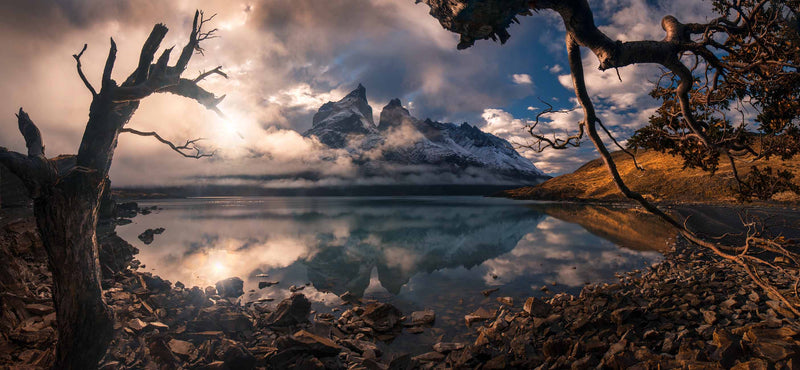
By far the best area to take landscape photos in Torres Del Paine is from the area around Lake Nordenskjöld . This is the lake right underneath Cordillera del Paine (the most beautiful mountains in Torres del Paine). The best spot on the shore is on the west side of the lake—but within this western area, you can still choose the eastern part of the shore. There is only one hiking trail here, which starts at Estancia Pudeto. There is a parking area here, with the trail leading first to Mirador Salto Grande. This is the viewpoint overlooking the giant waterfall Salto Grande.

This is where Lake Nordenskjöld flows into a 700 meter long river and into the Lago Pehoe. The trail leads you to a viewpoint overlooking the Nordenskjöld lake with the Cordillera del Paine behind it. The best shooting spots are all along the trail. From dead trees, sand-patterns, leading lines in stones and the water streams leading up to the Salto Grande waterfall. You can also find Guanacos here with a bit of luck!
The name of basically all the mountains you see in Torres del Paine is Cordillera del Paine. This is the whole mountain range. When I think as a landscape photographer, there are only a few peaks that really stand out, even though the whole group works as a team as well. The number one mountain for me is Cuerno Principal. At 2,251 meters, this is certainly not the highest. But since it is the closest to my favorite shooting area (Lake Nordenskjöld), it looks like the highest. If you Google the height of this mountain, you will, interestingly, find many different elevations. The 2,251-meter elevation seems to be correct based on my judgment and the Google Earth model. Whether it is the highest or not, it does look the most impressive. To the right of Cuerno Principal, you have Cuerno Este.

2. Mirador Cóndor
A popular spot among landscape photographers is Mirador Cóndor. This viewpoint is located around 210 meters above Lake Pehoé . The reason this spot is so popular is because of the combination of the colors of the lake, the small island with Hosteria Pehoe and of course the Cordillera del Paine in the background. Another reason is because it is directly located above the Hosteria Pehoe and the fact Torres del Paine has a limited number of accessible photography spots. If you want to do a little hike and see a nice view the Mirador Cóndor is definitely worth visiting. If you want a great photo in Torres del Paine I would not even consider this spot. Why mention it in this guide then? Because now you know to not include it in your photography.
3. Salto Chico Viewpoint
The entry to the Salo Chico Viewpoint is located at the intersection from the main road to the Explora Hotel. The viewpoint can be reached along a very unstable and in bad condition wooden walkway (2026). The hike is only a 100 meters long so great news for the non-hiker among us. The viewpoint offers a view on the Cordillera del Paine. What makes this view unique is that you can see a layer effect on the water. This is created by the bay of Lake Pehoé and a tiny island behind it. Even with wind you have a chance of seeing a (partly) reflection in the water of the bay. Now what about foreground from the viewpoint? There are some big green bushes called Westringia. In autumn they are often not in the best condition, but in Spring/Summer (November) they are full and beautiful. They can be used as foreground and can create a lot of depth.

4. Lake Pehoé.
Lake Pehoé is a giant lake, and gets most of its water from Lake Nordenskjöld through the Paine River. It also gets a bit of water from the Skottsberg lake. There are some great spots along the Pehoé lake for landscape photography. You are much further away from the Cordillera del Paine compared to shooting from Lake Nordenskjöld. Using a longer focal length is therefore recommended. Don’t fully include the mountain Cerro Paine Grande when you shoot in vertical - this mountain looks higher (and is) than the central Cordillera Paine, and will therefore make the composition unbalanced.

5. Mirador Las Torres
The Mirador Las Torres is also known as Las Torres Base viewpoint. You are standing underneath the towers the Torres del Paine are named for. The name of the Torres are Central, Monzino and Dagostini. The lake right underneath it is Lago Torres.
In order to shoot Las Torres at sunrise, you need to leave early. Allow three to five hours for the hike, depending on your hiking speed, which most likely depends on your fitness level and the weight of your camera gear. I recommend bringing only a wide-angle lens—a camera is also handy. You can also stay overnight at Torres Central/Norte Camping or Refugio Chileno (if they are open and have spaces available). Refugio Chileno saves you around one hour of hiking. Torres Central Camping doesn’t save you any hiking, but you don’t have to drive into the park from your accommodation.

Sunrise vs Sunset
Torres del Paine is famous for its sunrises. There certainly isn’t always a great sunrise—there is a good chance that clouds will cover the peaks or that no light will come through to hit the Cordillera del Paine. However, if the light does come through, you will have a high chance of great sunrise conditions in Torres del Paine. So why are the sunrises so good in Torres del Paine?

The screenshot from Google Earth (with the sun added) shows a view from the Cordillera del Paine towards the east. You can see that the horizon is pretty much flat—at least there are no mountains. This means that there are no mountains to block the light—and there are no mountains to catch other clouds. Of course, it can also be cloudy without mountains, but the chance of having a clear sky is higher. The Cordillera del Paine mountains do catch clouds, often coming from the Pacific Ocean to the west.

Another reason the sunrises are so good in Torres del Paine is that the area is all the way on the east side of the mountain area. The clouds come in from the west. This means that most clouds are stuck west of the Cordillera del Paine. This doesn’t mean that there are no clouds in the area—in fact, there are often plenty of clouds. But they are often not so thick that there is no visibility.
Sunset is simply not the best in Torres del Paine. Since the landscape is not a layer landscape (many different visible layers), a sun setting behind the mountains doesn’t bring any quality to the light. You can however try to make use of soft sunset light on your foreground object.
Summer vs Autumn
Most landscape photographers visit Torres Del Paine in the Autumn/fall season. While Los Glaciares National Park offers strong autumn colors, Torres del Paine does not—unless you go hiking on the circuits! I am talking about visiting the spots as a landscape photographer. This is simply because there is not that much forest anymore due to different wildfires (1985, 2005 and 2011). The autumn colors also appear later than in Los Glaciares National Park because the elevation is lower (around 100 meters in Torres del Paine vs. around 750 meters in Los Glaciares National Park). In summer, Torres del Paine has an advantage, which is the quality of light. The Cordillera del Paine catches more light at sunrise in summer, and the good light lasts much longer. This is because of the position where the sun rises.

On the left, you see a sunrise in April—which is in autumn. The sun moves to the north. At sunrise, some parts of the walls of the Cordillera del Paine will catch some light. But the amount of light becomes less as the sun moves to the north. In the summer season—for example, in the month of November—more of the mountain walls will catch light. The sun will also move to the north, of course, but at no point during sunrise will there be a lack of light hitting the mountains.
Stormy Conditions in Torres Del Paine
Torres del Paine is known for it’s incredibly high winds. No surprise with the Pacific Ocean on the west, followed by the mountains and the big lakes. The big lakes like Lake Pehoe and Lake Nordenskjöld often feel more like a sea than a lake. The stormy conditions will not be your friend if you want a reflection of the Cordillera Paine In your landscape photo. If it is indeed stormy, you can use the waves to your advantage. This kind of photography requires a trial and error approach. You keep trying until you get the best results. Here are some tips to increase your change of success:

• Use a shutter speed of around 1/10th of a second.
• Study the wave on a specific spot before going there with your camera – know the biggest potential wave.
• You can go close to the wave – making it the main foreground subject – or go further away and include other foreground elements.

Best Places to Stay in Torres del Paine
There are different options to stay in Torres del Paine. One thing you will notice however, is the high price. Because accommodation can not be built freely, the supply (accommodation options) is lower than the demand (number of tourists).
Hosteria Pehoe
If you want to be the nearest to the shooting spots I recommend Hosteria Pehoe. The best thing about this place is the view from the window towards the Cordillera del Paine over Lake Pehoé. Don’t expect luxury, but basic and decent rooms. Also, don’t order a brownie cake for 8 USD and expect it to taste something like a brownie—but as a European, I’ve never liked any pastry or cake in Patagonia; they are always too sweet for my taste. Expect to pay around 210 USD for a single room in the low season and 350 USD in the high season. In the autumn season, the price is around 250 USD. You can also contact them to put up your tent on their property for a high price, but I’m not sure how often you will end up flying above the lake, considering the chance of high winds!
Even though Hosteria Pehoe is inside the National Park and shooting areas, for most spots a car is still recommended. The parking to Lake Nordenskjöld is still 6km away. For me, the value of the location is therefore overrated, especially looking at the quality of the rooms for such a high price.
Hotel Rio Serrano
The best option for me is Hotel Serrano. This is a 4 star hotel and is located just outside the park. You have to calculate around 25/30 min of driving to the parking of Lake Nordenskjöld. This is something I don’t mind since you only drive once at sunrise and once at sunset. Other spots like Salto Chico Viewpoint take less time (around 18 min). The price of Rio Serano is a little bit higher than Hosteria Pehoe but the quality of the room is also higher. Still, don’t expect European quality accommodation like in the Dolomite’s or in France. The restaurant is decent with OK breakfast options - again don’t compare it to any restaurant in the Dolomite’s!
Alternative option
The cheapest option is to stay in the town Cerro Castillo, There is a decent quality hotel named Estancia El Ovejero Patagónico. The prices are around 200 euro for a night - which isn’t by any means cheap. The drive into Torres del Paine is around 1 hour and 10 minutes to the parking of Lake Nordenskjöld. This will take the fastest route following the highway 9 to the North, then making use of a new patch of road. Still, it is a long drive inside the park. Why would you stay here then if the drive is so long and the prices are not cheap? Probably when Hosteria Pehoe is fully booked and the price at Hotel Rio Serrano is too high for your budget. In my opinion the price at Estancia El Ovejero Patagónico is a bit overpriced considering it is so far away from Torres del Paine.
National Park Torres del Paine Entry Fee
You have to pay a fee when entering Torres del Paine National Park. There are three gates where they will check your tickets. One is just past the Río Serrano (river) on the southwest side. This is probably the one you will use as a landscape photographer. This gate is called Serrano. Another gate is considered the main entrance—this is on the northeast side and is called Laguna Amarga . This is also the entrance you will use when going to the base of the Torres.
There is also a third, less known one, called Sarmiento. Before sunrise and after sunset they will keep the gate open and won’t check your ticket. During office hours they now check everyone all the time for your tickets when you both enter and exit. Before, they only checked when you enter the park. You can pay the tickets at the ticket office or online at the Official National Park Page.
The actual prices for foreigners are as follows:
• No more than 3 days: $35 USD
• More than 3 days: $49 USD
• Children under 12 are free.
For Chilean Nationals the prices are lower.
Final Thoughts
If you are planning a trip to Torres del Paine, I also recommend checking out both our Ultimate Travel Guide and Ultimate Photography Guide to Patagonia . These articles go more in-depth about Patagonia which covers both the Argentinian and Chilaen sides of the area.




Share your experience, ask a question, or tell us what you would love to photograph.