


What is the Cordillera Blanca?
Located in the Ancash department, the Cordillera Blanca has the most glaciers ad the most high mountains peaks of Peru (even though the glacier coverage is shrinking rapidly). The Cordillera Blanca should not be confused with the Cordillera Huayhuash - this mountain range is smaller and further south, you can read all about it here: Cordillera Huayhuash Guide.
The Cordillera Blanca is also the biggest tropical ice-covered mountain range in the world. There are two main rivers. On the west side of the Cordillera Blanca you will find the Cordillera Negra (black mountain range). While the Cordillera Blanca is covered with snow and ice, the Cordillera Negra has no snow. The Santa River on the west side of the range flows into the Pacific Ocean. The Marañón River flows into the Atlantic Ocean - which is more than 3,000 km further!

Huascarán National Park
The Huascarán National Park is basically the Cordillera Blanca. It is a world heritage site and entry to this area requires you to pay a ticket. You can choose between 1 day, 2-3 tickets, or weekly tickets. The price starts at around 7 euro a person. You can buy them at the ticket office when entering the park or online here: Huascarán National Park Tickets.

The park is open 24-hours – which means you can still enter/exit when the ticket booth is unoccupied, for example during the night, early in the morning or late evening. If you do enter during the early or late hours, make sure you still purchase your tickets online or from the counter later in the day during opening hours!
Best Landscape Photography Spots Cordillera Blanca
1. Huascarán
The Huascarán National Park is located inside the Cordillera Blanca and is a World Heritage site. The 6,768 m (22,205 ft) is the highest mountain of Peru and the third highest mountain in the Andes. The mountain itself has two peaks. The main peak, Huascarán Sur, 6,768 m, and a sister peak, called Huascarán Norte (6,655 meters). The prominence of this mountain is the biggest on the west side, which is almost 4000 meter high. When shooting the Huascarán from the East side the prominence is a lot less: between 2,000 and 2,500 meter.
The best photo spots are on the east side past the lakes Quebrada de llanganuco and Lagunas del Valle Llanganuco. This area has many different flowers and streams you can use as foreground. The mountains (Huascarán Norte and Huascarán Sur) both catch light at sunrise and sunset. At sunset the clouds often cover the Huascarán Norte peak and leave the Huascarán Sur free of clouds. At sunrise the morning can start cloudless but be aware the clouds can come in quick and unexpected.

The small dirt road 106 can bring you up the opposite mountain. This place is the best to explore for foregrounds because you have a direct view on the Huascarán. As a landscape photographer, the Huascarán in the Cordillera Blanca, is not the best mountain to photograph. This is because of the round shape and the fact that both mountains look a bit similar. Maybe in another 3 million years erosion has shaped it into something more spectacular.

You can also shoot the Huascarán from the west side. From here it is mostly mid to long lens, unless you are fine with having houses, roads and the chaos of the Peruvian towns in your photo. The shape of the mountain is different of course but still not spectacular.
2. The Mountains Tocllaraju, Huandoy and Huandoy Sur
The Tocllaraju (6,034m), Huandoy (6,395 m) and Huandoy Sur (6,160 m) are mentioned together because they are so close to each other and always shot in one composition. The best place in the Cordillera Blanca to photograph them is from the south side. You will have light at all peaks in the morning and the sun will set behind the peaks at sunset. The morning are more clear and the sunsets more clouded.

What applies for the Huascarán also applies for these mountains - the morning can start totally clear but clouds can form and come in quickly. The best place to shoot these mountains is from the same area as Mount Huascarán - from the opposite mountain (Yanarrajo) when driving up the 108 road. You can also shoot it from the north slopes of Yanarrajo.

For foreground you are using the same kind of flowers or even the exact same flowers as when shooting Huascarán. The difference is the focal length you should use. While the Huascarán is giant and closer to your position, the Tocllaraju, Huandoy and Huandoy Sur are further away and a little bit lower. Around 10mm more focal length is recommended.

Besides foreground flowers you can also shoot the clouds on top of the Tocllaraju, Huandoy and Huandoy Sur. Or better, the jet streams. Because of the high elevation, the winds on top of the mountains reach such a speed they become visible. Always keep your eye open for this occurrence because they can form out of nowhere.

3. Chakrarahu (south side)
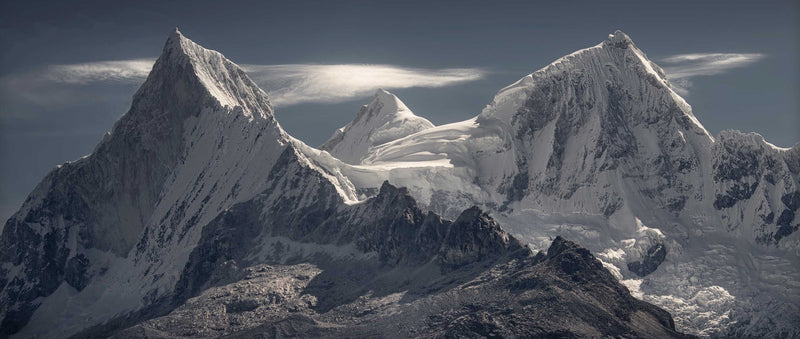
The Chacraraju mountain, 6,108 m (20,039 ft) in the Cordillera Blanca from the South side has a spectacular shape and has many snow-ridges. A snow ridge gives the mountain detail and texture. You can reach the shooting spot by going to the north side of the Yanarrajo mountain. You will find here lupine flowers, white cacti, yellow flowers and more foreground options.

The mountain itself will only catch a little bit of light during sunrise and no light at sunset during the meteorological winter season (May to August).

During the meteorological summer (Nov to February) the sun can potentially hit the south side at sunrise but because of the rain during this season the change is small you will see it during a 3-day visit.

Still, the Chacraraju has so much snow and ice, it will often reflect the surrounding light from clouds or the early twilight glow.

4. Chopicalqui (south side)
My favorite mountain to shoot in the Cordillera Blanca is the Chopicalqui mountain (6,354 m/ 20,847 f). This mountain is popular among climbers, but still relatively undiscovered among landscape photographers. The best light on Chopicalqui is during the twilight glow at sunrise. The mountain glows up and you can see all the details and impressive snow ridges. Direct sunlight on Chopicalqui doesn’t look as good because of the high contrast and the angle of the mountain only lets it illuminate a few parts of the mountain. This difficulty can be solved when there are soft clouds at sunrise.

At sunset the light can be great if there are enough clouds in front and above the mountain - illuminating the mountain indirectly. At sunset the change of clouds is high while at sunrise the change of clouds is much lower. Yes, this mountain doesn’t have the best conditions and therefore it is recommended to calculate a few days around this mountain.

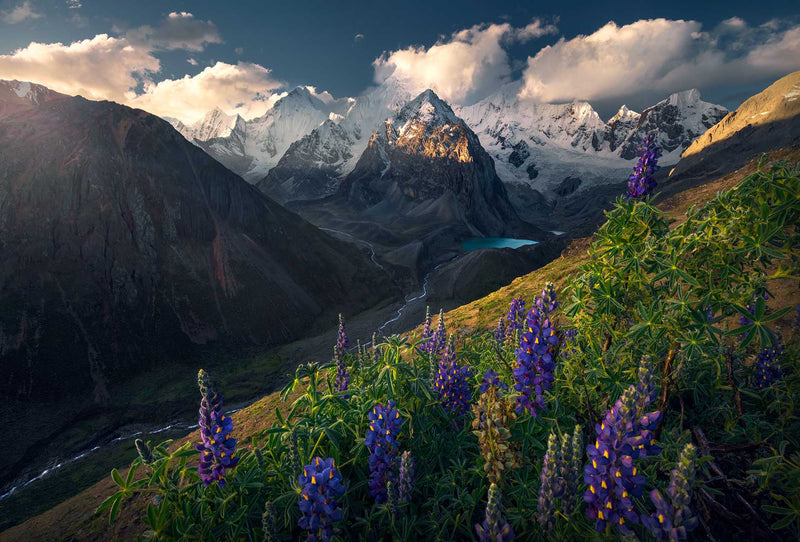
The shape of the mountain is more beautiful than spectacular. The snow-ridges are the best part, but these only stand out with the right light. The foreground options are the best part of this mountain. There are many different flowers, cacti and lupine’s. The most noticeable one is the Pink Viper Bugloss, as pictured above. They look amazing but can be a challenge to compose because of it’s size and shape. Add to the foreground flowers, many different streams which all point to the Chopicalqui and you understand why this spot is so good.

Incredible lupin flowers in the mountains of Peru.
To get here can be a bit difficult. During my Peru Tour we will make use of porters to setup camp on a secret spot. Then you need to hike by the side of a river before entering the area where you can explore. If you go alone I recommend spending a week before you get it all right. If you have less time joining the Peru Tour (limited spots) is a good idea.

Other Interesting Spots
Here are some other interesting spots worth considering. I have not included them with the best landscape photography spots because they are simple not the best, or they can be too difficult to reach as a landscape photographer.
1. Lago 69
Lago 69 is located in the Huascarán National Park - just like most of the other spots. The lake is accessible by two hiking routes. The first is the direct route. This one can be busy because most visitors in this valley do the hike. The other route is called the Panorama Hike and is longer, more beautiful and way less crowded. At the time of writing this, the route is closed due maintenance but will be open at some point. You can find many bus services who will bring you to the starting point of the hike and will also have return services.
The lago 69 is beautiful. The color of the lake, the white mountain Chakrarahu towers above it and there are also small trees and a waterfall coming down from the mountain. The reason I don’t consider this a top spot is because you are too close to the mountain. You are standing right underneath it and therefore you don’t have the depth with layers and the shape of the mountain isn’t as vertical. More than half is stone field so this big empty space doesn’t help. Still, if you are in the area it is fun to check it out. Do keep in mind this lake sits around 4,600 m (15,100 ft) so you have to take around 5 days of acclimatization into account before going here (as a general guideline).
2. Laguna Paron
The Laguna Paron is accessible by car from the town of Caraz. The drive to the start of the lake takes around 1 hour and 30 min. Keep in mind it is a dirt road and it is not in the best condition. The lake is 3,7km / 2,3m long and is the biggest in the area. The Laguna Paron is an artificial lake because it’s a reservoir but that doesn’t take away any of it’s beauty. On the far end of the lake (the East side) you will find Artesonraju mountain on the left (6,025m), the Pirámide (5,885m) in the middle, and the Chakrarahu on the right (6,108m). The Pirámide looks the most prominent since it is exactly behind Laguna Paron. When you drive further along the shore, which is on the north side of the lake, the Chakrarahu mountain becomes more visible.
For landscape photography it is more difficult to find foreground flowers. Also the landscape doesn’t have the depth with layers compared to other spots. Therefore I consider it as a beautiful place to visit, but not the best for landscape photography.
Best Places to Stay in Cordillera Blanca
Inside Huascarán National park, the national park inside the Cordillera Blanca, there are no places to stay other than a campground. But outside you have different towns where you can stay and also acclimatize.
Huaraz
Huaraz is the capital of the Ancash region. You have both busses and airplanes going from Lima to Huaraz. The town offers also a wide range of excursions to higher locations such as lakes and glacier views. However, the town itself is not the prettiest. Huaraz is located at 3,052 meters/ 10,000 feet. Therefore it is a good place to acclimatize. There are many accommodation options available on booking.com. A few good hotels in Huaraz are the following:

• The Cuesta Serena Boutique Hotel. This is the most luxurious place just outside Huaraz. Greats views on the Cordillera Blanca and Huascarán.
• The Cordillera Hotel. A really good hotel for a fair price in the center of Huaraz.
• Hotel Morales. Offers both basic and more luxurious rooms. A good balcony view from the top offers a view on the surrounding mountains of the Cordillera Blanca.
Yungay
The small town of Yungay is more beautiful than Huaraz and is closer to Huascarán National Park. It sits at a lower elevation of 2515 meter, which can be too low for good acclimatization.
• Huandoy Lodge & Restaurant - a beautiful lodge and a very good restaurant, which comes at a fair price. The location is near the main road. You have a view on the high mountains but they are a bit far away.
• Casa Hotel Alpamayo - a basic but well prices hotel and also restaurant. This place is popular among the locals because of the good food at the restaurant. Located at the main road to Huaraz and Huascarán national Park.
• La Casita de mi Abuela - a basic, but good quality accommodation with good friend and friendly staff. It also has restaurant and airport shuttle (to Huaraz airport).
01
Final Thoughts
With all this information in mind, you can now plan the perfect landscape photography trip to Cordillera Blanca or make it easy and join our next Peru Tour! I recommend combining this article with the Ultimate Photography Guide Cordillera Huayhuash and 5 Best Places in Peru for Photography for an even more detailed itinerary. We have written it all, to make it easy for you!




Share your experience, ask a question, or tell us what you would love to photograph.