How did you get into landscape photography?
I started taking photographs at fourteen, almost by coincidence. After my father passed away, I was carrying his ashes into the mountains, and I experienced a feeling that I would now describe as the sublime. There was something about the scale of the landscape that was overwhelming and difficult to explain. I started photographing it, and it has been landscape photography from the beginning.
That experience still shapes my relationship with mountains. Photography became a way of expressing something very personal, and over time I became more serious about learning how to communicate that feeling through an image.

What has been your biggest photography adventure so far?
It would have to be my trip to Tibet about three years ago. Some of the places were so remote that when I sent my drone up, all I could see were layers and layers of mountains stretching for miles. There was no Wi-Fi, no phone signal, and we were travelling off-road, completely away from everything familiar.


The cold was intense, and I got frostbite on my fingers during the trip. It was a difficult experience, but the landscape had a different kind of beauty. Even now, I find it hard to describe properly. The photographs can show you the mountains, but explaining how it felt to be surrounded by that much space is much harder.

You joined us on our Peru tour in 2026. Which location was your favourite to photograph, and why?
It has to be the Paradise Mountain viewpoint on the last day of the tour. I had seen a photograph of it a long time ago, and I found it difficult to believe that a place like that could actually exist.
The mountains line up so perfectly, and then you have these tropical plants in the foreground. That combination is extraordinary. Seeing it in person after having that image in my mind for so long made it especially memorable. It’s hard to imagine finding that same arrangement anywhere else.


Beyond the photography, what were some of your favourite moments from the Peru tour?
One of the highlights was seeing how Max works as a professional landscape photographer, from the initial planning through to the final edit. I’ve spent so much time learning through my own experimentation that being able to observe that whole process in person was fascinating.

When you arrive at a location, how do you approach the shoot?
I usually start by walking around and exploring different viewpoints before setting up. I want to understand the space and find a composition that feels right. Once I find it, I’m happy to wait for the light.
I used to keep the framing simple, with relatively little sky or foreground, so the main subject held your attention. But as I’ve evolved and improved, I’ve found that complex compositions can work perfectly for me as well.

Where do you find inspiration outside of photography?
I think everything we do, see and watch influences what we make, often subconsciously. I’m especially interested in how people from earlier centuries responded to the same landscapes that move us today. Looking at Albert Bierstadt’s The Matterhorn, painted around 1867, I’m struck by the fact that someone so long ago also recognised something extraordinary in that mountain and felt compelled to express it.

With so many people photographing landscapes, how do you try to make your work stand out?
For me, the identity of my work comes from my relationship with the landscape. The remote locations, simple compositions and darker tones work together to express that connection.
I’m still figuring out a consistent visual language. I want the photographs to communicate something personal, and I think that develops through the experiences I bring to them.

“For me, the identity of my work comes from my relationship with the landscape.”
Many of your images have a distinctive, dark and moody feel. How did you learn post-processing, and how did your editing style develop?
My editing developed quite intuitively. In the beginning, I approached it as a personal interpretation of the landscape, experimenting until the image felt close to how I remembered the place. As I became more serious, I would spend hours in Lightroom, trying things and seeing how changes in colour and tone affected the atmosphere.


Since the tour with Max and Madee, I’ve been spending those hours experimenting in Photoshop as well. The tour opened up more possibilities for me, particularly with colour grading. I’m still learning how to use those tools, but the intention is to give the image the feeling I want.
What have been the biggest challenges in improving your photography so far?
Getting useful feedback is a big part of it. When you work on your own, it can be difficult to recognise what’s missing or understand what you should work on next. Guidance helps you see things you might otherwise keep overlooking.
I’ve also realised that progress is uneven. You can spend a long time experimenting without feeling that everything is coming together. Finding a consistent style, and the right medium for what you want to express, feels like one of the hardest parts of making any kind of art.

How much does social media influence what you photograph or choose to share?
Instagram does influence me a little, because it’s another place where I absorb ideas, knowledge and different ways of seeing. Even casually scrolling exposes you to images that might stay with you.
I tend to share photographs from wherever I’ve been travelling. My recent Peru photographs from the trip with Max and Madee seem to have done particularly well with the algorithm, which has been interesting to see.

Could you share three of your favourite photos you’ve taken and tell us a little about the story behind each one?
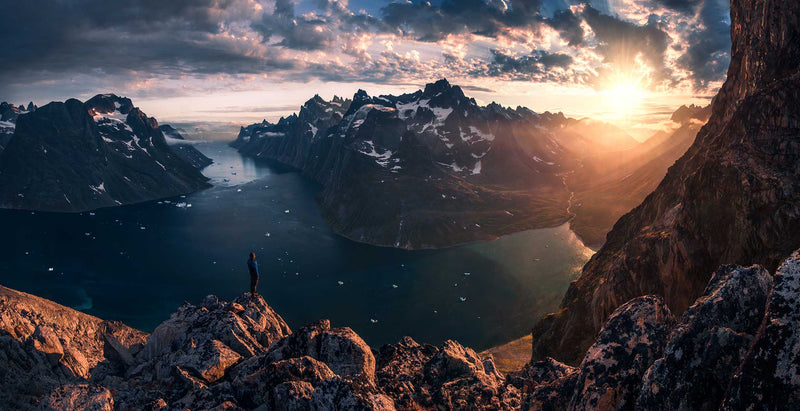
Photo 1: Finland

I took this on my birthday, around Riisitunturi National Park in Finland. The trip was my girlfriend's idea. We hiked up without snowshoes, which made the journey really painful because the snow was just crazy. When we made it to the top at around 11am, this miracle moon appeared.
It really should be called a wonder. I had never seen any of those colours before, especially the moon when it turned pink-red. I guess those might be the Arctic colours, and I'm so glad we got to witness them together.
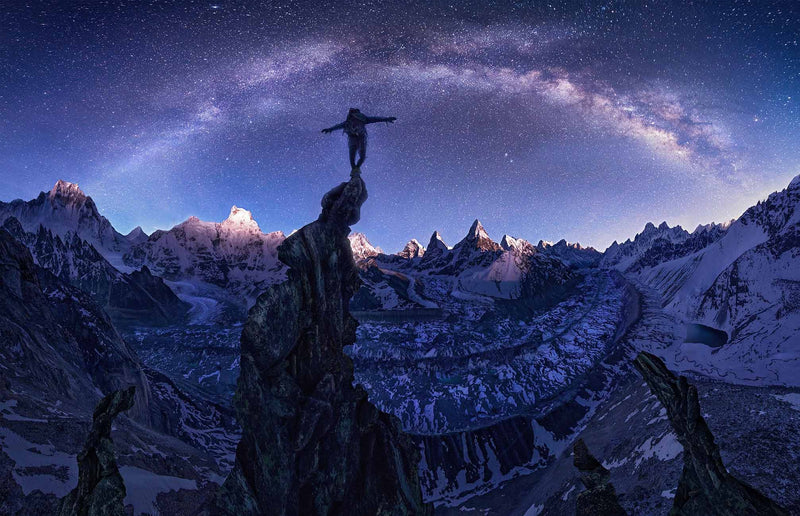
Photo 2: Tibet

This is the one from the Himalayas that I talked about earlier. It is Mount Makalu from the Tibet side, 8,485 metres, the fifth-tallest mountain in the world, in the morning alpenglow.
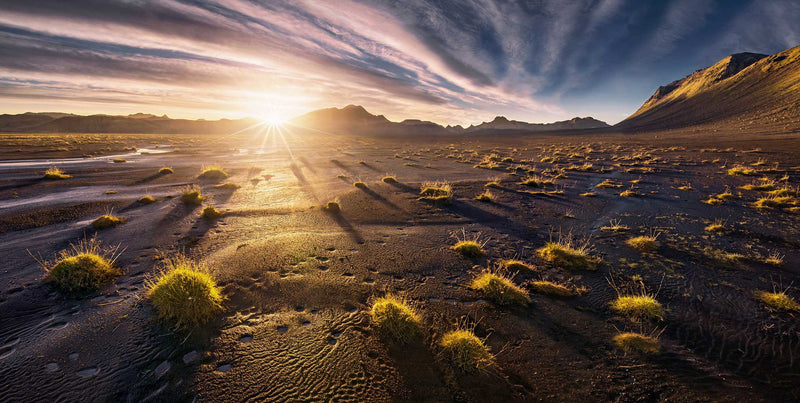
Photo 3: Peru

The last one was taken in Peru on this trip with Max and Madee. I walked around for a while looking for a foreground, and then I found this woolly cactus. I had never seen plants like these before this trip, and it looked almost unreal sitting in front of those mountains.
The sky was really heavy that day, so I set up and waited. Then the clouds opened for a moment and the light landed right on the valley. It didn't last long, but it was enough.
Where would you like to take your landscape photography in the future?
I have quite a few projects in mind. Some involve telling stories about my family, and others are more focused on landscapes. I’m interested in developing both sides of my work and finding the right way to express each of them.
For future landscape trips, Patagonia and Saudi Arabia are two places I’d really like to explore. At the moment, there are a lot of possibilities, and I’m still working out which ideas to pursue first.

How do you think AI will shape the future of landscape photography?
It’s a difficult question because the technology is advancing so quickly, and as individuals we can feel that we have very little influence over its direction. It reminds me of earlier arguments about photography itself. In the nineteenth century, critics such as Charles Baudelaire questioned whether photography could be considered art. New technologies have a way of making people reconsider what artistic work means.
For me, photography also has a deeply physical side. With film, light acts on an emulsion, an image is developed, and a print can be made in the darkroom. The materials, decisions and time involved are part of the work. I believe that experience of making something physically will continue to matter, whatever AI becomes capable of generating.
At the same time, I worry about what happens to the images we share online, including whether they become material for training AI. It can feel as though our creative work becomes free labour for systems we have little control over. AI may change landscape photography and many other fields, but I don’t believe it can replace the meaning of art as a physical, human practice.

What advice would you give another young person who wants to get into landscape photography but doesn’t know where to start?
Start with places that make you curious or mean something to you. Give yourself time to explore and pay attention to what you respond to. Those experiences gradually shape the photographs you want to make.
I would also encourage people to experiment and seek useful feedback. Spend time with your images, try different approaches, and ask people who can help you understand what could improve. Finding your own style takes time, and progress won’t always feel consistent. I’m still going through that process myself.