


Now that I understand what focus stacking is and how it works, I’ve come to appreciate the incredible detail and depth it can bring to an image. It’s especially powerful when you want your foreground to pop while still keeping the background super sharp.
01
What is Focus Stacking
Focus stacking, also known as focal plane merging, z-stacking, focus bracketing, or focus blending, is a digital image processing technique used to increase the depth of field in a final image. It involves capturing a series of photographs at different focus distances and then merging them into a single composite image where all the desired elements appear sharp and in focus.
This method is especially popular in landscape photography and also macro photography, where achieving sharpness from the nearest foreground detail to the distant background in a single exposure can be technically challenging. By combining focused areas from each frame, focus stacking produces an image with enhanced clarity and a stronger sense of depth throughout the entire scene.

02
When is Focus Stacking Best Used?
The first step is to identify your scene. Most often, you'll be shooting with a wide-angle lens to capture as much of the foreground as possible. A classic example is photographing flowers up close with a mountain in the background. But wide-angle flower shots aren’t the only situations where focus stacking shines.
Here are a few other ideal scenarios:
• Cave scenes where you want both the edges and background in sharp detail.

• Forests with leading lines created by tree trunks or roots.

• Cracked mud or textured ground when shooting low to the ground.

• Waterfalls or winding streams where both the foreground and flow need to stay sharp.

• Any low-angle shot where your camera is low to the ground or nearby objects dominate the foreground.

• When shooting at night at a high aperture (low f-number). The low f-number decreases the range which appears to be in focus.

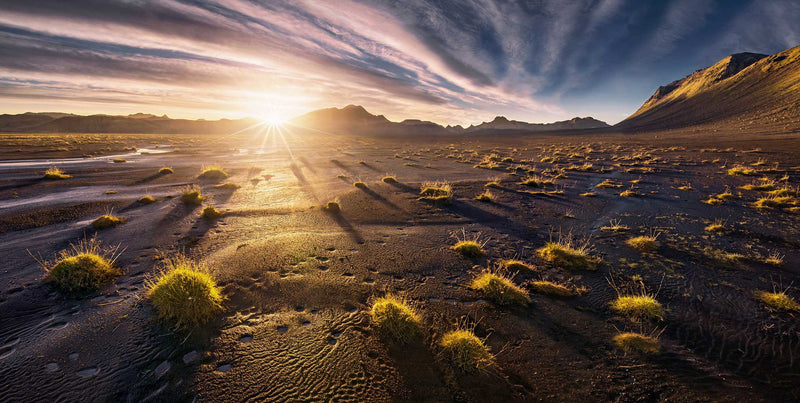
Maybe that was an overkill of examples, but you now have a strong visual idea of how focus stacking looks in a finished photo. In all these cases, focus stacking helps you capture sharpness from front to back—something a single exposure just can’t achieve due to lens limitations.
03
How to Focus Stack in the Field
To shoot your images in the field, you want to identify your epic composition first. Start by taking a photo with the focus set on the background. Then, without moving the camera, change the focus to the foreground and pick a specific point that stands outs as being the best focus point of your image and take another photo. Nothing else changes—don’t move, don’t breathe—just adjust the focus point. To give you an idea of what the focus point could be, check the image below on where I would choose to focus if I was choosing just two focus points.

As you can see, I have chosen a focal point in the foreground which is the center of a leading line and close to the viewers eye. This means that the surrounding area is likely to be sharp too. Now when these images are combined the focus will go from the leading line in front to the mountain beyond.
Using a different example below, here is how I would take this photo if I wasn't using the focus stack technique. I would focus somewhere in the middle of the frame so most of my background is sharp and most of my foreground is sharp. But it would not look as detailed as this finished result does, because this result has been achieved through focus stacking.

The more of the foreground you want in focus, the more shots you’ll need to take, each with a slightly different focal point.
For example, I might take several foreground shots, adjusting the focus each time - either on individual flowers or different zones in the composition and of course, always one for the background. Below you can see how many focus points Max actually selected for this result.

04
Top Tips
In most situations, you don’t necessarily need to get a perfectly focused shot of every individual foreground object (like flowers). Usually, just one image focused on the foreground and one on the background is enough to get a decent result. You only need to take an in-focus photo of each individual flower if there’s a significant distance between them. But I recommend you take multiple shots with different focus points regardless if you need them or not. Even if you only end up using three out of five in post-processing, at least you have the option to choose the sharpest ones.
Flowers are actually one of the most difficult subjects to focus stack. Especially anything vertical like flowers, plants, or grasses, because they usually have background visible behind them. Compare that to something like a tree root lying on the ground, even though it has a bit of vertical shape, it’s much easier to stack because there’s less background interference.
Another thing to consider is your aperture. Using a high f-number like f/14, f/16, or even f/20. This can help increase your depth of field, depending on the scene and the level of sharpness you’re aiming for.

Now, how do you focus stack when it’s windy? Simple! You increase your ISO and use a faster shutter speed. But what happens when you have multiple flowers moving around? The solution is to focus on each flower individually—both in terms of movement and focus. Then, in post-processing, you can cut and paste them into a scene where there are no flowers in that spot.
This means two things: one, you need to make sure each flower is sharp; and two, don’t shoot during hard wind gusts if you can avoid it. Realistically, it comes down to taking a lot of photos, and then coming home with a puzzle you’ll need to piece together. Or, as Max describes it, gathering all the recipe ingredients you need to make your final meal.
If you're photographing something in the foreground and plan to do this kind of compositing, take a clean photo slightly to higher with the focus set on the background. That way, when you cut and paste the flowers back into the final image, your foreground won't look messy or cluttered—it gives you a clean base to work from.

Max says, think of it like cooking a meal. It's better to have all the ingredients than to realize halfway through that you're missing something essential. The more shots you take with specific focal points, the more flexibility you'll have when editing. You don’t have to use every single focus point image that you take, but it's better to have it and not need it, than wish you'd taken more.
05
Post Processing
Once you're ready to edit, open both photos (or all your focus-stacked shots) in Photoshop—or Lightroom first, if you want to make RAW adjustments. It’s important to open them at the same time so they get the same RAW edits. This keeps the lighting, contrast, and color consistent so your final image looks natural and cohesive.
Once you’ve made your RAW edits, open the images in Photoshop—this is where the real work begins.
There are two main ways to focus stack.
The First Method – Copy & Paste Technique
Here is the final image from our example before. As you can see from the additional height above the foreground subject, this technique works best when you’ve taken an extra photo of your background from a slightly higher angle to give yourself more separation between foreground and background.

1. Copy your foreground.
2. Paste it onto your background.
Wait—what if it doesn’t align perfectly?
Good thing you’re a technical wizard and know how to resize an image! If the alignment is off because you dared to breathe between shots (we’ve all done it), simply resize or reposition your foreground to match the background. You might need to blend the edges using the Spot Healing Brush or the Clone Stamp Tool at low opacity to clean up any obvious lines or mismatches.
Because you took the background photo from a slightly higher angle, it should be easier to drop your sharp flowers into place and make the merge look seamless.
The Second Method – Background Removal & Clone Stamp (a.k.a. Max’s Way)
This method starts with a clean background photo—ideally one where the foreground is out of focus. The goal is to remove that blurry foreground and then replace it with a sharp version from your stack. For example like this:

Use the Spot Healing Brush to remove the blurry foreground. This is usually the quickest and easiest way to clear space.

The blurry foreground flower has been removed using the spot removal tool.
Finally clone stamp in your sharp foreground image and blend it in. Keep in mind, sometimes the Spot Healing Brush leaves behind artifacts or weird smudges. That’s when the Clone Stamp Tool comes in handy to tidy things up and get a clean result.

The sharp flowers getting added using the clone stamp tool.
An extra tip: When shooting, if your nearest foreground is too close to get in focus, try moving your camera back a little and zooming in. For example, if you're shooting at 50mm and struggling to get the nearest flower sharp, try zooming out to 20mm and stepping back. This can make it easier to get that nearest flower in focus. Even if it ends up slightly smaller than the other flowers due to the zoom and depth being different, the added sharpness usually makes up for it, and the overall image will still feel more powerful because of the clarity.
Auto Focus Stacking Modes
There are also semi-automatic focus stacking modes. For Nikon cameras, this feature is called Focus Shift Shooting . It allows you to set the number of shots, the focus distance for each shot, and the interval between shots. Start by focusing on the nearest object. The advantage of this mode is that it captures the photos very quickly in succession, which helps prevent excessive camera movement—especially when shooting handheld. The downside is that you don’t have precise control over exactly where the camera will focus. It simply takes a series of images based on the initial settings.
Personally, I prefer to do everything manually—but sometimes when I'm not using the Nikon D810 I shoot with a lightweight Nikon Z8 and a 14-30mm lens. Combined with the touch-and-shoot function (where you tap the object you want to focus on via the touchscreen, and the camera focuses and shoots), and a stable position, this method works perfectly for me. If my camera didn’t offer this feature, or if it were significantly heavier, I would consider using the Auto Focus Stacking mode. Other major camera brands also include this feature in their latest models.
People often wonder how I manage to get sharp results when shooting at slow shutter speeds—even while focus stacking. The secret lies in finding a stable position, and there are several ways to achieve this.When your subject is low to the ground, sit down on your butt. I understand you often need a certain height, and that can vary depending on the situation.
You can adjust by resting the camera directly on your knees, holding the camera in your hands while resting your elbows on your knees, or simply holding the camera steadily with both hands. These are just a few examples—you can be creative in the field. In addition, when you shoot, try holding your breath to minimize movement. If your camera has a touch-to-focus-and-shoot function, use it. If not, try using a 0.5-second shutter delay. This helps prevent camera shake when pressing the shutter button.
06
Final Thoughts
As I said in the introduction, focus stacking is an advanced technique - it’s not something you master overnight. It requires knowing what to shoot in the field and a lot of practice in post-processing.
Your first few attempts might feel frustrating or even chaotic. You might come home with dozens of files, only to realize something didn’t align, or a gust of wind ruined that perfect flower shot. That’s all part of the learning process. Don’t let it discourage you.
What makes focus stacking so rewarding is the level of detail and depth it can bring to your images.






Share your experience, ask a question, or tell us what you would love to photograph.