


01
When Shooting Into the Sun Works
From a High Viewpoint
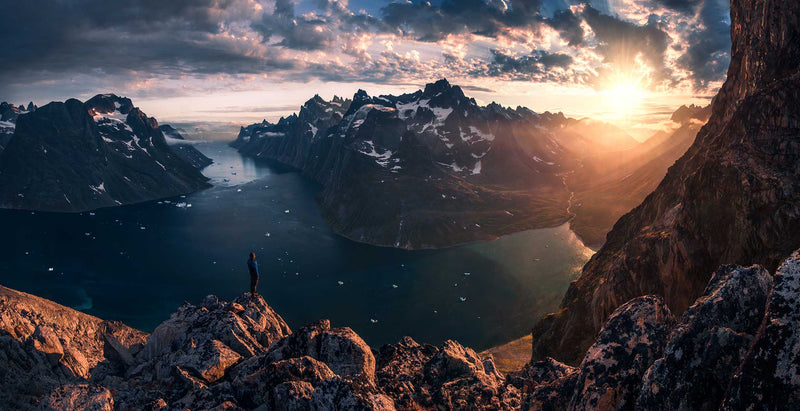
When you are standing on a high view point, and there are layers visible, the sun can create a tonne of depth between those layers. For this, the sun needs to be high enough in order to shine inside all those valleys. You have to find a good height of the sun, where it isn’t too high (and creates harsh conditions) and not too low, that it doesn't shine inside the valleys anymore. Sunrise is easier than sunset, since you often start shooting when the sun rises. For sunset, I often aim to be too early. This way you have a safety margin in case it happens to be great when the sun is still high up in the sky. This can be the case when the clouds semi block the sun. More about that later.
There are also other elements of a high viewpoint which determine how much of a difference the sun will make when it's in the frame. Without going too much into detail, I will briefly discuss them here. One, consider if the sun will have an opening to shine into the landscape. What I mean can better be explained with an illustration. See down below.
When the sun has an opening to shine into the valley it's a great thing to include the sun. When the mountain blocks the sun from shining into the view it is not a good idea.
When the Sun Creates Light-Rays
The sun can create light-rays when it is above a mountain ridge with many (often small) peaks. The sun needs to be well above the ridge but also not too high. It is the same principle as with normal mountain layers. When you have a location where a mountain has this character, it is well worth trying to see how it looks when the sun is above it. If the mountain ridge-line is round-shaped you won't have any light-rays (think about the hills of Scotland). When the mountain ridge-lines are rugged and pointy (like in the Dolomite’s) you have a good chance of seeing light-rays. Keep in mind, this can be both from a high viewpoint, from the valley floor or anywhere in between.

Lightrays above the mountains in Vallée de la Clarée, France.
Not only can the landscape create light rays, but humidity is also an important factor. The higher the humidity, the better the light rays will appear—at least until visibility becomes too low, of course. The ridge line in the above photo has the perfect shape for light rays that don’t require high humidity. In most other cases, however, the rays will not be strong enough to be visible unless there is decent humidity.

Senja Midnight Sun. The high humidity in combination with sea-fog created some incredible light rays.
Yes, you will always have some degree of light rays when the full sun is above the mountain. To be precise, humidity alone is not the only factor—the dew point also plays a role. But that becomes more important if you want fog on the ground. For now, let’s focus only on light rays, which mainly require high humidity.
Some areas are known for consistently high humidity, such as Vietnam, Indonesia, and Thailand. Other regions have more varied climates where conditions can be both dry and humid, such as Patagonia, the Alps, and Norway. In these areas, it is recommended to check the weather forecast in advance.
Websites such as Wunder Ground will show you predicted humidity amounts.
When There is a Lack of Subject
The sun is a real attention-grabber—it is an incredibly bright spot. It will almost always be the first, or one of the first, subjects your eye is drawn to. You can use this to your advantage in a scene that lacks a point of interest in certain areas. Of course, the sun needs to rise or set in the part of the image where that interest is missing. So, besides reading the composition (knowing where it lacks a subject or point of interest), you also need to know where the sun will be at the planned shooting time.

Without the sun the panorama would lack a point of interest in the middle.
When it Adds Symmetry
When the sun is in the middle, it can create a focal point. This also helps make the image look more symmetrical—and symmetry is often a strong feature in landscape photography. To make this work, both sides of the image need to be balanced. They don’t have to be perfectly balanced—if they were, the scene would already be symmetrical. But with the sun in the middle, some degree of balance is still necessary.

This sunstar adds a strong focal point and creates symmetry.
When it Adds balance to the Composition
As explained before, the sun adds a lot of visual weight to an image. In the earlier example, we used the sun to fill an area that lacked a subject. But what if the entire image is missing a strong subject? In that case, you can think about “adding” two subjects: the sun on one side, and a person on the other. The important thing is that they balance each other. If the sun is positioned in the middle of the right half, you’ll want the person to be placed in roughly the same area on the left half. If the sun is closer to the center, then the person should also be positioned near the center.

If I was standing too close to the sun here the left of the image would feel empty. Balance is key!
When it Creates Shadows (you can use as leading line)
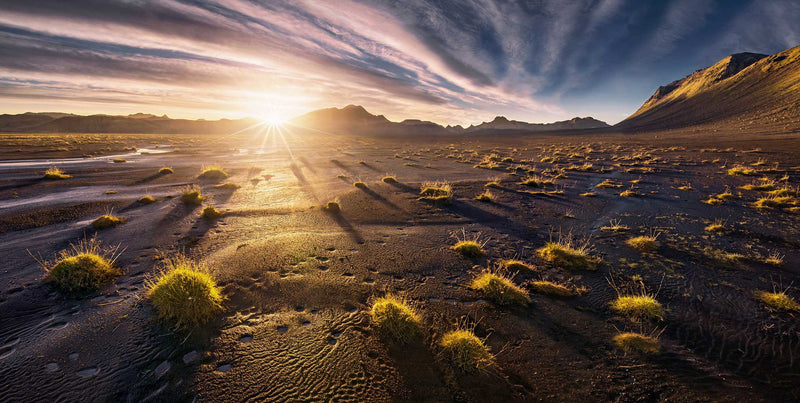
Light and shadows are often a challenge for landscape photographers. High contrast can make a scene look busy, and shadows can be too dark to reveal good detail. However, there are situations where including both light and shadows in your composition is actually beneficial. This is especially true when the sun creates long, clean stretches of shadow that form natural leading lines. The cleaner the surface (for example, smooth sand or freshly snow-covered hills) and the simpler the objects (like rocks or cacti), the better the shadows will appear. Best of all, these leading lines created by shadows almost always point directly toward the subject—the sun.

When it Illuminates Waterfalls
Now, this may sound like a downside, since the sun often creates harsh contrast on water that can be unpleasant to look at. While that’s true, it’s also worth considering how softer light—such as that created by low sun, a partially blocked sun, or even moonlight—can transform the scene. In these conditions, the light touches the edges of the waterfall, adding depth and creating a beautiful light effect.

When a Leading Line Connects With The Sun
A good example of natural leading lines are the shadows created by the sun—they always point back to the sun itself. In this case, though, I’m talking about different types of leading lines, such as a branch, a stone, a mud crack, or any other object in the scene. These are often easiest to spot when the sun is already in the desired position. It’s much more difficult to pre-visualize them when scouting during the daytime. Still, it’s worth keeping this in mind and knowing where the sun will rise or set when you’re scouting in advance.

To Add Warmth to an Otherwise Cool Landscape.
When shooting a landscape dominated by cool color tones, warm color tones are always welcome—they create a beautiful color contrast. Without the cool tones, the warm tones won’t stand out as much. To showcase both cool and warm colors, you need the right weather and conditions. This means having a mix of (thick) clouds and, of course, an opening for the sun. You also need a wide enough field of view in your shot to capture both the warm and cool areas. This is often easier to achieve with a wide-angle lens than a telephoto zoom, and even better with a multi-shot panorama. When photographing the sun in a winter landscape, you naturally get this warm-cool color contrast.

02
Settings For Shooting into The Sun
This is simple—just underexpose the image. You need to read the scene to determine how much to underexpose. If you manage to block the sun, you won’t need to underexpose much, or only slightly. Shooting into the sun with a thin layer of clouds around it creates more challenging conditions. The way I handle it is by taking multiple exposures—not for exposure blending, but to make sure I don’t overexpose the sun. I then edit the brightest photo in which the sun is not blown out. If the light conditions are difficult, I will do an exposure blend. Later, I’ll discuss how to prevent lens flare in the field and how to capture the perfect sunstar.
03
What is Lens Flare
Lens flare occurs when sunlight hits the camera lens, creating visual artifacts such as green or red colors, dots, and circles. Beyond these obvious artifacts, shooting directly into the sun can also wash out the entire image. It’s almost as if there’s another semi-transparent layer over the photo, reducing contrast and saturation.
04
How to Fix Lens Flare
One way to fix lens flare is to remove it in post—more on that later. For now, I’ll start by discussing a technique to minimize lens flare while shooting landscapes in the field. This method requires taking two or more different photos and can be done on a tripod or handheld.
The first photo should be taken with the sun blocked from shining directly into the lens. To do this, place your hand at least 25 cm away from the lens—using one or two fingers, or your whole hand—to shield the sun. This prevents direct sunlight from hitting the lens. The resulting photo will look like this.

The second photo is taken with the sun in the frame. You can then merge the two photos together. The challenge here is that the sun creates a strong glow around it, which can be recreated in the photo without the sun during post-processing. See my tutorial on how to do this here.
When the distance between the sun and the mountains or other landscape elements is large enough, you can often merge the photos without any adjustments in post.
In Photoshop, the easiest way to remove lens flare is by using the Spot Healing Brush Tool. This works well for both small and larger areas of lens flare.
05
How to Shoot into The Sun with Drone
While you can block the sun with your hand when using a regular camera, that technique is much harder with a drone (unless you’re flying it yourself). Still, there are ways to minimize lens flare. First, I try to shoot when the sun isn’t too low on the horizon. A higher sun doesn’t shine as strongly into the lens compared to a lower one.
Second, when I do include the sun in the frame, I try to position it directly in the middle. This produces less lens flare than placing the sun near the edge of the frame.
Lastly, I often take a multi-shot panorama with a drone. This allows most of the photos to be captured without significant lens flare. For example, when shooting a 3x3 panorama, I move my gimbal downward until there’s no—or minimal—lens flare. That becomes my middle row of photos. The top row will then have some lens flare, which can be removed in post-processing, while the bottom row typically remains flare-free.

You can also consider using a lens hood for your drone. This helps block more sunlight from hitting the lens. It works best when the sun is just outside the frame you want to capture, but it won’t help when shooting directly into the sun. In that case, you’re often better off without it, because a lens hood can make the difference between photos with the sun hitting the lens and those without more pronounced. Without a lens hood, the transition between photos with the sun directly in the frame and those further away is softer.
Since I often include the sun and shoot multi-shot panoramas, I don’t use a lens hood. However, if you prefer not to include the sun and have it just outside the frame, it can be a useful tool.
06
The Perfect Sunstar
A sunstar is considered perfect when it looks clean, with a relatively small core (the sun) and well-defined, distinct points. Achieving perfection is often difficult, but getting a good result is already a worthwhile goal.
First, shoot at a high f-number (small aperture). This limits the amount of light entering the sensor. For example, if you shoot the sun at f/22, you may also want to take an additional photo at a lower f-number to maximize sharpness, as f/22 is not always the sharpest aperture.
In addition, underexpose the image. In post-processing, you can then increase the exposure and lower the highlights. This produces a smaller (overexposed) sun core. Exposure compensation is necessary; without it, the area around the sun may appear too dark compared to the rest of the image.
Besides camera settings, the scene itself is even more important. In some situations, you may not be able to create a sunstar at all—for example, when the sun is partially obscured by thin, but dense enough, clouds. This can result in a relatively thick, overexposed area rather than a clear sunstar.

Now we got the least favorable condition out of the way, let's discuss some more positive conditions. Let's say there is a clear sky, and there are some objects in the area. Such as a tree. Now you want to semi block the sun with the object. Test out how much of the sun you want to block. The more you block the sun, the smaller the sun and vice versa.

In the above example you aim to semi-block the sun with an object while the sun is still well above the horizon. Another option is to wait till the sun is setting behind the horizon. When it starts to touch the ridge line it is time to shoot. You will continue shooting until it has completely disappeared behind the mountain. You will have around 40 seconds from full sun to no sun. I recommend to start shooting while the sun is still too strong and finish not before the sun is totally gone, because you never know beforehand when the perfect timing is going to be. You will end up with many photos and can select the one you like best. An additional advantage of shooting a sun which is about to go behind the horizon is the fainted light capture on the mid-ground.

07
Final Thoughts
When done intentionally, shooting into the sun can be a really impactful way to add to your composition. Understanding when it works, choosing the right settings, and knowing how lens flare behaves allows you to control the light instead of fighting it. The key is preparation and practice. Experiment with different angles and conditions and have fun! If you enjoyed this article, check out Composition Techniques in Landscape Photography for more tips!




Share your experience, ask a question, or tell us what you would love to photograph.