


Switzerland - Staubbach Falls
Considered a landmark of Lauterbrunnen, the Staubbach Falls are located in the canton of Bern, Switzerland. They are a renowned attraction, known for their show-stopping display as they cascade from the sheer face of a cliff into the scenic valley below, where visitors can stand and witness the beauty up close.

Adding to the charm of the surroundings are the traditional Swiss mountain huts and the village below.
The waterfall drops 297 meters from a hanging valley, ending in overhanging cliffs above the Weisse Lütschine River, and is the highest free-falling waterfall in Switzerland. Lauterbrunnen is one of the best places in the world for photography, with many other unique spots nearby and of course the Swiss Alps too.

Staubbach Falls is a must-visit destination, not only for its unique descent into the valley but also for its special location.
In fact, I rate this area so highly that I’ve written an entire Ultimate Guide to Lauterbrunnen here. I highly recommend checking it out for more detailed tips on Staubbach Falls and other waterfalls in the region.
How to shoot it:
As a photographer the best spot is to shoot is from a higher viewpoint. The best photo spot is above the valley, near the village of Wengen (at 1,274 meters). From here, you can see the three waterfalls: the Buchenbachfall, the Spissbachfall, and the Staubbachfall (from left to right – or from farthest to nearest). You can also see the 4,164-meter-high Breithorn in the middle of the far distance.
How to get to the tourist viewpoints:
If you want to be a tourist, the best way to view Staubbach Falls is to get to Lauterbrunnen train station and then hike along the footpath. You can already see the waterfall when you arrive at the station, so getting from there to the start of the trail should be super easy. Just follow the crowd (most likely tourists) and head towards the waterfall. It’s only a 5-minute walk to the falls.
By public transport:
Take a train to Lauterbrunnen station. Walk south along the main road through the village, as shown on the hiking map above. It’s about a 10-minute walk to the base of the falls.
By car:
Drive to Lauterbrunnen and park in the metered lot next to the church – 46°35’31.7″N 7°54’28.4″E. If that lot is full, you may be able to park in the Lauterbrunnen parking garage behind the train station – Gütli 481, 3812 Wilderswil. The path starts on the private road next to the parking lot, leading south into the valley.
How to get to the photography viewpoint:
From Lauterbrunnen, you can reach Wengen only by public transport, on foot, or by bike. From Interlaken Ost station, it takes 37 minutes to get to Wengen. The blue-and-yellow Bernese Oberland Railways (BOB) train will take you to Lauterbrunnen.

Taken near the village of Wengen, Pictured is Spissbachfall and Staubbach falls.
Important: Sit toward the front of the train, as the rear cars split off at Zweilütschinen. If you sit in the back, you’ll take a detour to Grindelwald instead. In Lauterbrunnen, you’ll need to change to the yellow-green train of the Wengernalp Railway (WAB).
One option is to take the train from Lauterbrunnen to Wengen. You can travel all the way to Wengen and then hike down, or you can get off one stop before the final station at Wengwald. From here, you’ll find various small roads and trails leading down the mountain. You are already in the shooting area as soon as you leave Wengwald, so there's no need to hike much further.
Trains run every 30 minutes from Lauterbrunnen Bahnhof. The journey takes about 13 minutes to reach Wengen, or 10 minutes to reach Wengwald. A single ticket costs around 7.20 Swiss francs at the time of writing, and a return ticket from Lauterbrunnen to Wengen costs around 13 Swiss francs.
If you want more details on hiking routes, check out the hiking information in this guide here.
France – Cirque de Fer a Cheval
The Cirque du Fer-à-Cheval is a large valley in the Giffre Massif, located 6 km east of Sixt-Fer-à-Cheval. The town of Sixt-Fer-à-Cheval lies south of Abondance and on the way to Chamonix. To reach the town, you’ll need to drive for about an hour along a scenic road, passing through valleys with beautiful rivers and mountains on both sides. Sixt-Fer-à-Cheval is located near the Giffre River. It’s a small village with a few houses, a restaurant, and some terraces.

Though small in width, it cascades down the face of the mountain, adding character and intrigue to the entire scene.
Before you judge me for choosing this tiny waterfall, let me explain. For me, this waterfall is particularly special because of how it blends with the surrounding landscape. As I mentioned in the introduction, waterfalls can be impressive subjects on their own, but I believe the best way to photograph a waterfall is when it’s integrated or combined with an incredible mountain backdrop. At least, that’s my opinion! This waterfall is a perfect example of integration.
How to Get There
From the town of Sixt-Fer-à-Cheval, drive east along the D902 road, heading towards the Cirque du Fer-à-Cheval. You'll drive through a beautiful alpine landscape, passing picturesque villages and forests. As you approach the Cirque du Fer-à-Cheval, the road will take you further into the valley, where you’ll begin to see the towering cliffs and waterfalls. The main car park for Cirque du Fer-à-Cheval is located near the entrance to the valley, at the foot of the mountains.
There are large parking lots here with spaces for cars and buses, and it's an ideal starting point for visitors exploring the area. It's only a short walk from the car park to the start of the hiking routes that lead into the valley and along the waterfall paths. A tarmac road makes the location easily accessible year-round. Disabled parking spaces are located approximately 150 meters from the restaurant. A bus service operates from Morillon, Samoëns, and Sixt-Fer-à-Cheval during the winter season (December to April) and the summer season (July to August). Be aware that, due to an increase in tourism, parking is now subject to a fee.

While the waterfall is not the only subject, it’s a crucial element of the scene.
Best season to visit:
Best season is late spring till early summer. This is because during this period the chance of having enough water in the waterfall is the highest. The stronger the waterfall, the more noticeable it is as a subject and the stronger the composition. As a bonus, this season also has wildflowers you can use as foreground. The weather during the summer months are also the best. Even though it can be very hot in summer, you will have a higher chance of dramatic weather. What I mean by this is that high temperatures often lead to heavy rainfall and thunderstorms. The clearances and clouds create misty valleys and interesting cloud formations on the top.
How to shoot it:
This area offers many composition possibilities. In summer, and provided there hasn’t been a crazy heatwave that’s dried up the flowers, you may find some lovely wildflowers to use as a foreground element. Another great option is shooting from a river or stream in the valley, facing toward the mountain. Depending on rainfall, the stream might be a key part of your composition, creating mini waterfalls that form natural leading lines. If the water level is lower, you might find interesting rocks that can serve as leading lines.
This shot is less about photographing the waterfall itself and more about capturing the epic combination of mountains and waterfalls. Without the waterfall, the mountain would lose a lot of its visual interest, so it’s an important feature that you might not initially think of, but would certainly miss if it were absent.
Norway - Låtefossen Waterfall
This is a massive waterfall originating from Lotevatnet lake. What makes it special is that it begins high up and splits into two separate streams before merging again into the river below. Standing at 165 metres (541 feet) tall, it is a unique and well-known tourist attraction in the area. Just before the two streams descend, they join together midway down the waterfall—just before passing beneath Norwegian National Road 13. This road, built between 1867 and 1869, includes an old, six-arched stone bridge, which mean you can get really close very easily! For for those driving across the bridge it's a cool experience. The bridge itself can be included as foreground; especially if you like bridges and old stonework. I think it is quite unique.
How to get there:
Låtefossen is easily accessible and conveniently located right off the main Road 13, which connects the towns of Odda and Røldal. The waterfall is situated in Oddadalen, often referred to as "The Valley of Waterfalls" due to the numerous waterfalls in the area. Låtefossen itself is the most famous of these, making it a top tourist destination, but not always known to landscape photographers. The waterfall is just a short walk from the Road 13.
In addition to the waterfall, Oddadalen offers several hiking routes and scenic viewpoints, making it an excellent destination for hiking too. Whether you're stopping for a brief photo op or planning to explore the surrounding area, Låtefossen is a perfect starting point to experience the stunning beauty of Norway’s fjord landscape.

My favorite position to shoot from is in the valley, along the riverside, where you can capture the waterfall on the left flowing into the river below.
The trees in the valley also add a lot of interest, serving as both mid-ground and background elements. You shoot it with the bridge on the left side – this way you can see multiple leading lines (created by the foam) floating through the bridge openings into the river. While including the bridge on itself doesn’t have my preference, there is no way around it if you want to include the river as well. For me, the bridge is part of the Låtefossen waterfall.
Best season to visit
The Låtefossen waterfall is at it’s strongest in spring until early summer because of the melting water from snow. However this waterfall doesn’t need to be at it’s strongest since it is already so big and powerful. Therefore I think the best season to visit is in the summer months because of the green colors and the chance of having flowers above the shoreline. Another option to consider is late September until November when trying to include the Northern Lights.
Norway - Seven Sisters Watefall
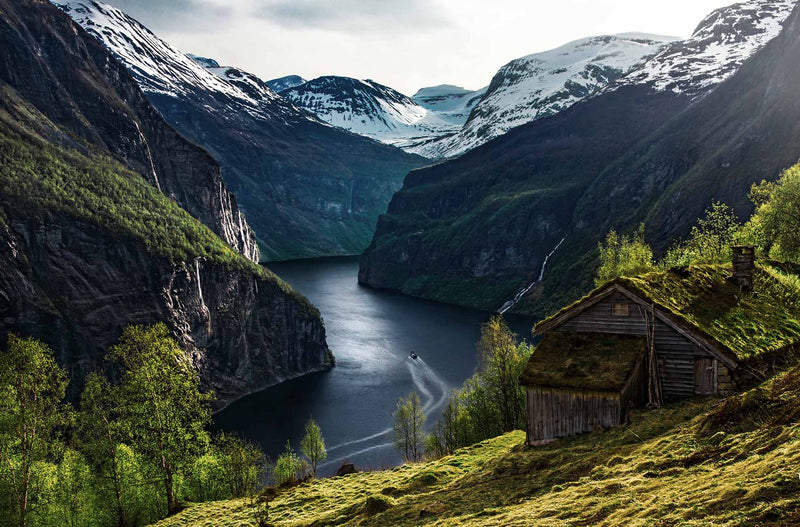
Located in the Geirangerfjord, the Seven Sisters Waterfall consists of seven separate streams, with the tallest free-falling 250 meters (820 ft). Many people choose to view this incredible waterfall by boat, which also provides great opportunities for photography — although I’ve never done this myself.

This waterfall is special to me because it adds great depth and direction to this mountain scene.
As part of the larger landscape, you can see many small waterfalls nearby. There are plenty of options for photographing this waterfall. Because of its versatility as a subject, I think it definitely deserves to be on the list!
The best time to visit the Seven Sisters Waterfall is between May and July, when the snow-melt is at its peak and the falls are at their most powerful. This season also has intense green colors and snow on the higher parts.
How to Get To Geiranger:
Reaching Geiranger can be done a few different ways. If you're driving from Ålesund, the journey takes around two and a half hours via the E39 and RV63 highways. The route offers stunning mountain and fjord views, especially as you approach the famous Eagle Road (Ørnesvingen). During the summer months, buses also run from Ålesund or Åndalsnes to Geiranger — Nor-Way Bussekspress and local bus services are worth checking for current schedules.

You can even connect it with another waterfall — for example, shooting a random waterfall from one side while the Seven Sisters is visible in the distance.
How to Get To Skageflå Farm:
I chose to photograph the waterfall from a distance to capture the sense of scale and depth it adds to the surrounding landscape. To get a similar vantage point, you’ll need to hike to the historic Skageflå farm, which sits high above the fjord. The hike is about 8 kilometers (5 miles) one way, takes around 4 hours, and includes an elevation gain of roughly 550 meters (1,800 feet). Although the elevation gain isn’t extreme, the trail is still demanding and shouldn’t be underestimated.
You can start your hike from the parking area at coordinates 62.100727, 7.204873. Skageflå was once a remote working farm, active until 1918. Due to its isolation, it was cut off from the local village in winter. According to local legend, one of the final owners removed the ladders leading up the rock faces to avoid visits from the tax collector and thus paying his tax. Today, all that remains are a few old buildings and a viewpoint — but with the fjord, the mountains, and the Seven Sisters waterfall in the background, it’s a really unique spot and a fantastic alternative to the more typical views of the falls.
Iceland – Seljalandsfoss Waterfall
Seljalandsfoss is one of Iceland’s most iconic waterfalls and a favorite among photographers. Located in the South Region of Iceland, right off Route 1 (the Ring Road), it’s incredibly easy to access. The waterfall plunges 60 meters (197 feet) from the cliffs above, fed by the Seljalands River, which originates from a glacier-capped volcano. What makes Seljalandsfoss especially unique is the pathway that allows you to walk behind the waterfall and into a shallow cave. From a photography perspective, it offers a variety of interesting angles, with the view from behind the falls being particularly surreal and magical.

From the south-side of Seljalandsfoss waterfall it is nice to see the ridge-line of the mountain leading into the distance. You can also see the river but it doesn’t lead into the distance as well compared to the north-Side.
How to get there:
To travel to Seljalandsfoss the most common way to get there is by Car from Reykjavi. This is because public transport is limited an infrequent especially in non-tourist seasons. Even with public transport you will still need to hike a bit to get there. I recommend checking bus routes on Straeto for up to date information.
Seljalandsfoss is about 125 km (78 miles) southeast of Reykjavik. The drive by car from Reykjavi takes approximately 1 hour and 45 minutes. Take Route 1 (the Ring Road) heading east.The waterfall is clearly signposted and located just off the main road. There’s a parking area right near the falls, with a small fee for parking.
Best season to visit:
The Seljalandsfoss can be shot in every season. In summer and spring the waterfall is the strongest due to snow-melt. The source is both melting water from snow, glaciers and spring-fed water. That is also why the waterfall is also active in winter. In the winter season you can also include the Northern lights. Especially when shooting the Seljalandsfoss from behind the cave-view, the Northern Lights can make for a great image.
How to shoot it:
The great thing about the Seljalandsfoss is that it can be shot from three different angles. Each side looks completely different. From the north-side you have a nice view into the distance, creating more depth. The advantage from this side is that you can also see the river leading into the distance and you can find wildflowers as foreground.
Last but not least, it can be sot from behind the waterfall. This perspective is by far the most popular. During the summer months you can have the sun in the frame, creating warm colors. Keep in mind to use an ultra wide angle lens, or to make a multi-shot panorama to capture the whole waterfall in one frame.
Iceland – Hafragilsfoss Waterfall
Hafragilsfoss is a powerful and lesser-known waterfall located in northeast Iceland, within Vatnajökull National Park, not far from the more famous Dettifoss. It plunges around 27 meters (89 feet) into the Jökulsárgljúfur canyon, which was carved by the glacial river Jökulsá á Fjöllum.
What makes Hafragilsfoss unique, especially in long exposure photography, is the force of the water — the spray is so intense that it often appears like an explosion in the photo, creating a dramatic effect. The waterfall itself is quite clean; you can clearly see the flow of the river and the distinct lines where the water drops.

Use a long exposure for the waterfall to get a nice effect on the spray. I recommend 2 seconds or longer. Compose the waterfall in the middle for a symmetrical composition
One of the things I personally appreciate is that it hasn’t been photographed as much as other Icelandic waterfalls, making it feel more special. That said, getting to a composition here can be risky. I had a close call while climbing for a better vantage point — I had to lower my backpack first to descend, and it ended up tumbling partway down the cliff with my camera inside. So, if you're exploring this area for a special shot, take extra caution — the terrain can be steep and unstable.
How to get there:
Hafragilsfoss is just a 10-minute drive north of the Dettifoss parking lot (on the west side). There is a small parking area and a short walking path to a viewing point over the canyon and waterfall. The viewpoint is on a cliff, offering a dramatic perspective, but there are no safety rails, so caution is needed. While Dettifoss also has an east-side access road (864), it's a rough gravel road and does not lead to a good Hafragilsfoss viewpoint. The west side (via Road 862) is strongly recommended for visiting Hafragilsfoss.
How to shoot it:
You can shoot Hafragilsfoss from the viewpoint. The viewpoint can be reached by following the main road 864, driving 5 min past the Dettifoss. This is the east side of the waterfall. The west side requires some serious hiking. From the viewpoint you can only shoot it from a distance. The waterfall and river is surrounded by a canyon – which is a bit difficult to get down to. In case you have the experience and preparation – you can use plants as foreground. The best foreground you will most likely find is Angelica archangelica as pictured above.
Waterfalls of Norway
This is for all the small and unique waterfalls you can find throughout Norway. If you're already in Norway, or planning a visit for its incredible landscapes or a special event like the Northern Lights, I highly recommend doing a bit of scouting on Google Earth to discover hidden waterfalls.

One of the thousand waterfalls in northern Norway/Evenes area.
Or if you don’t like to do pre-scouting you can also simply head out to photograph in a particular area, and chances are you’ll come across waterfalls you didn’t even know existed.

Many of the waterfalls I’ve photographed in Norway were found by just being in the right place at the right time—spotting something interesting and wanting a closer look. That curiosity often turns into a photo opportunity, with the waterfall becoming the subject or a foreground element.
Many of the waterfalls I’ve photographed in Norway were found by just being in the right place at the right time—spotting something interesting and wanting a closer look. That curiosity often turns into a photo opportunity, with the waterfall becoming the subject or a foreground element.

For example, with this particular waterfall, I was already in the area to photograph the mountains. I happened to be driving between locations when I glanced to the side and saw it coming down the hillside. A quick 30-minute hike towards the top if it and I decided it was worth returning for sunrise.
The waterfalls in Norway are especially impressive after heavy rainfall or during times of significant snow-melt. Do be aware that this often means the terrain you are exploring is more likely to be slippery and unstable!

Midnight Sun near the mountains of Evenes.
Final Thoughts
So those are my top seven picks for waterfalls in Europe. I know some of them may be a bit controversial because they aren't necessarily impressive in their own right, but think big picture! Especially with the Cirque de Fer a Cheval waterfall, it makes that mountain so much more impressive. Additionally all the un-named waterfalls in Norway, some of my best shots there have been from exploring. You just have to accept that sometimes it might be a big fail but it will be worth it for a big win! That's just the nature of landscape photography.




Share your experience, ask a question, or tell us what you would love to photograph.